
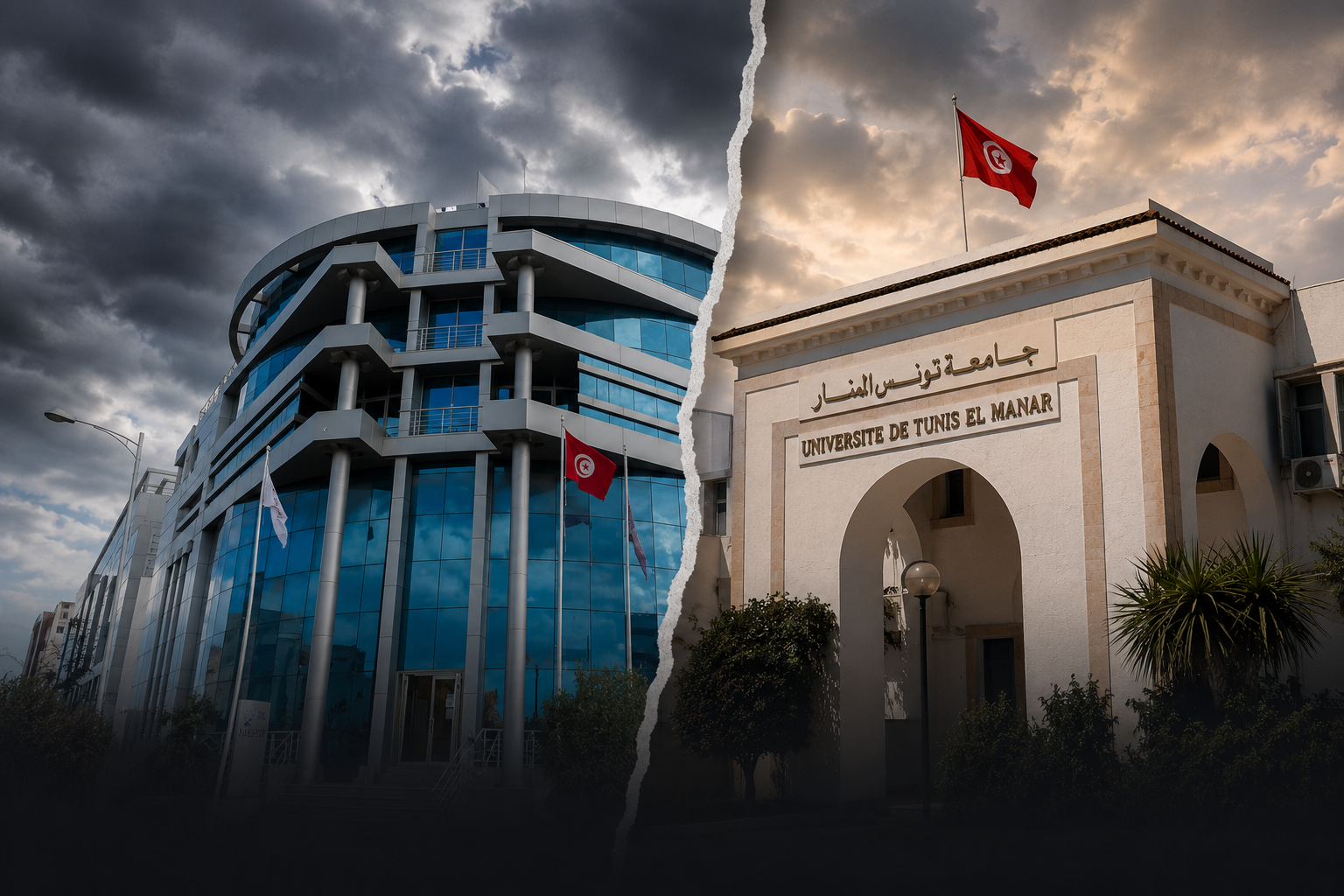
I recently followed the debate between the Tunisian Order of Engineers and the Ministry of Higher Education regarding the status of graduates from private universities and their right to obtain the professional title of engineer. Although the issue appears, at first glance, to be a legal or professional dispute, I believe it reflects a much deeper problem: the nature of the economic model adopted by the Tunisian state.
At the heart of the controversy is the authority legally responsible for recognizing graduates of private engineering schools. The Tunisian Order of Engineers maintains that registration should be limited to graduates of institutions that meet its accreditation and quality standards. The Ministry of Higher Education, supported by the Tunisian Union of Industry, Trade and Handicrafts (UTICA), argues that the recognition of national degrees falls under the state's authority through the ministry, and that private institutions operating under legal authorization should not be subject to additional professional accreditation before their graduates are allowed to practice the profession.
I do not hide my support for economic freedom and private initiative. I believe that every citizen has the right to establish a business that complies with the law, whether it is a private university, an industrial enterprise, or a service company. This is not an exceptional position. It is the model adopted by most countries, from France to the United States, where the public and private sectors coexist across most areas of economic activity. I also believe that wealth creation and capital accumulation are legitimate objectives, and that the role of the state is not to discourage investment, but to establish fair rules that ensure competition and equal opportunity.
For this reason, I support, in principle, the establishment of private universities operating under a clear regulatory framework that guarantees the quality of education without being so restrictive that it discourages investment or so permissive that it undermines academic standards. The state's role is not to prevent investors from entering the market, but to ensure that competition remains fair and that education continues to be a high quality public good rather than a privilege shaped by networks of influence.
The Real Issue Is the Economic Environment, Not Private Universities
The real issue in Tunisia is therefore not the existence of private universities, but the economic environment in which they operate. In a competitive economy, institutions succeed by providing better education, employers recruit the most qualified graduates, and society benefits from higher educational standards. However, when networks of influence emerge between certain private universities and specific firms, competition gradually gives way to closed privileges, and access to employment becomes increasingly determined by personal connections rather than merit.
This is where I believe the real risk lies: the emergence of a rent-seeking economy within the higher education sector.
If certain firms begin to recruit almost exclusively from a small group of universities, systematically offering internships and employment opportunities to their graduates, while graduates of public universities, despite the quality of their education, remain excluded from these networks, then the labor market will no longer reward merit. Instead, it will reward membership in networks of influence. Public university students would no longer feel that they are competing on the basis of their abilities and hard work, but rather entering a labor market where opportunities are unequal and where their future depends more on personal connections or financial means than on knowledge and competence.
I am not claiming that this has already become the norm. However, I believe there are warning signs that deserve attention before they evolve into an established reality.
A Rent-Seeking Model Could Spread to Student Financing
This model could eventually extend to the banking sector as well.
France provides an illustrative example. The country has both prestigious public and private institutions, yet banks offer student loans on favorable terms, enabling students from middle and lower income families to pursue higher education. As a result, access to high quality education is not reserved exclusively for the wealthy.
In Tunisia, however, the banking sector has long been criticized for providing insufficient financing to new businesses across several industries, an issue highlighted in reports and studies published by the Tunisian Association Against the Rent Economy (ALERT). If the same logic extends to higher education, the country could face the following scenario:
- Private companies increasingly recruit graduates from a small number of private universities.
- Public universities gradually lose quality or become less attractive in the labor market.
- Families feel compelled to enroll their children in private universities to secure better employment prospects.
- Wealthier households can afford the tuition costs.
- Middle income families, however, may struggle to obtain sufficient student financing, limiting their children's opportunities despite their academic ability.
If such a scenario were to materialize, education would no longer serve as a pathway for social mobility. Instead, it would become a mechanism for reproducing privilege, reinforcing a rent-seeking economy, and restricting upward mobility. Educational opportunities, employment, and wealth would increasingly circulate within a narrow circle of influential families, rather than being allocated on the basis of merit and ability.
Three Priorities for the State
At the same time, I do not believe that the solution is to restrict private universities or discourage investment in higher education. On the contrary, I believe that the state should fulfill its proper role: protecting competition and ensuring equal opportunity. In my view, this requires the state to focus on three key priorities.
First, it should strengthen public higher education so that it can compete at the international level.
My own experience illustrates this point. I studied for five years at French public institutions, first at Sorbonne University and later at the Paris School of Economics. At no point did I feel that public education was inferior to its private counterpart, nor did I feel that my academic or professional prospects were threatened by the existence of private universities. When public education is strong, it does not fear competition. Instead, it benefits from it, because competition is based on quality rather than privilege.
Second, the state should prevent the emergence of privileged networks that restrict access to the labor market for qualified candidates.
This could involve monitoring recruitment practices, ensuring equal access to internships, and establishing rules that prevent the unjustified exclusion of graduates from public universities, while fully respecting employers' freedom to recruit the candidates they consider most qualified.
Third, the state should expand access to affordable student financing, particularly through public banks or government-backed loan guarantee schemes. Such mechanisms would allow students from middle and lower income families to attend private universities if they choose to do so, ensuring that private education does not become a privilege reserved for those who can afford to pay.
Education, Parental Income, and Equal Opportunity
Perhaps the greatest danger any country can face is allowing access to higher education to depend on family income rather than students' abilities. This is not merely a theoretical concern. It is a pattern documented by the French economist Thomas Piketty in Capital and Ideology. Drawing on data from the United States, Piketty shows that the probability of attending higher education increases almost linearly with parental income. In 2014, the rate of access to higher education was barely 30% for children of the poorest 10% of households, compared with around 90% for children of the wealthiest 10%.
FIG. I.8. Parental Income and University Access, United States, 2014
Rate of access to higher education, by percentile of parental income
Interpretation: In 2014, the rate of access to higher education (the share of 19–21 year-olds enrolled in a college, university, or other institution of higher education) was barely 30% for children of the poorest 10% of households in the United States, and around 90% for children of the wealthiest 10%. Hover or tap the chart to read the rate at any percentile.
Sources and series: piketty.pse.ens.fr/ideology — Thomas Piketty, Capital and Ideology (Harvard University Press, 2020), Fig. I.8. Figure redrawn by the author from the published series.
The significance of this figure does not lie in criticizing private universities. Rather, it illustrates what happens when access to education is driven more by financial resources than by equal opportunity. Under such conditions, education ceases to function as a vehicle for social mobility and instead becomes a mechanism for reproducing existing privileges. Children's educational opportunities become increasingly determined by their parents' wealth rather than by their own talent and effort.
This is the source of my concern. The problem is not the existence of private universities, but the economic and institutional environment in which they operate. If the systems of education, employment, and student financing are allowed to evolve around networks of privilege rather than rules that promote competition and equal opportunity, Tunisia could eventually follow the same path. In such a society, a student's future would depend less on hard work and ability than on family income or access to influential networks. Education would no longer serve to reduce inequality, but would instead become one of its principal drivers.
The Real Paradox: A State That Chooses the Wrong Role
What does all of this have to do with the title of the article?
Some may argue that the state should not intervene in the private education market, and that allowing educational institutions and firms to operate freely is a fundamental principle of a market economy. In principle, I agree. A market economy is built on freedom of investment, freedom of contract, and competition.
However, this argument becomes misleading when economic freedom is considered in isolation from the conditions required for it to function properly. When markets are not genuinely competitive but are instead dominated by networks of influence and entrenched privileges, state inaction no longer represents a defense of capitalism. Rather, it amounts to indirect protection of a rent-seeking economy. What appears to be respect for market freedom may, in reality, conceal a closed system in which opportunities are repeatedly allocated within a narrow circle of economic insiders.
This is why the issue of private universities is, for me, only one example of a much broader phenomenon.
In a previous study on Tunisia's public enterprises, I examined the opposite side of the same paradox. I showed how the state intervenes extensively in sectors where it should instead promote competition and private investment, whether through state monopolies or by granting public enterprises regulatory privileges that make market entry for new competitors exceptionally difficult. The result has been lower productivity, weaker investment, reduced innovation, and growing fiscal burdens from public enterprises that face little competitive pressure.
In the present case, however, we face the exact opposite situation. Here, the market does not require the state to withdraw. It requires the state to act as a regulator and a guardian of competition. It needs a state that prevents the emergence of privileged networks, protects equal opportunity, and ensures that the freedom to invest does not become the freedom to dominate markets. Yet, in many cases, the opposite occurs. The state adopts a rhetoric of non-intervention while privileges and networks of influence continue to expand without effective oversight.
This is the paradox that the title of this article seeks to capture.
Conclusion: Neither Capitalism nor Socialism
The problem lies neither in capitalism nor in socialism, but in the state's failure to choose the appropriate role.
When the economy requires greater competition, the state intervenes by closing markets and restricting entrepreneurship and investment. When markets require a strong state to dismantle monopolies and protect competition, the state withdraws, justifying its inaction in the name of market freedom while allowing rent-seeking to reshape the rules of the economy.
This is why I describe Tunisia's economic model as a distorted model. It fails to apply market principles where they are needed, while also failing to intervene where state action is necessary to preserve competition. The case of private universities is only one illustration of this broader pattern.
Across several sectors, the state tolerates the emergence of privileged networks under the banner of protecting the freedom to invest. In practice, however, this allows a limited group of actors to dominate production, finance, or employment opportunities, preventing new competitors from entering the market. At the same time, in other sectors, the state maintains monopolies and regulatory barriers that restrict private initiative, even though these sectors would benefit from greater competition and market entry.
This is the core of the problem. Tunisia is neither a genuinely capitalist state nor a genuinely socialist one. Rather, it is a state that intervenes when markets should be liberalized and withdraws when competition requires protection. The distortion of Tunisia's economic model therefore stems neither from capitalism nor from socialism themselves, but from the misguided application of both.