
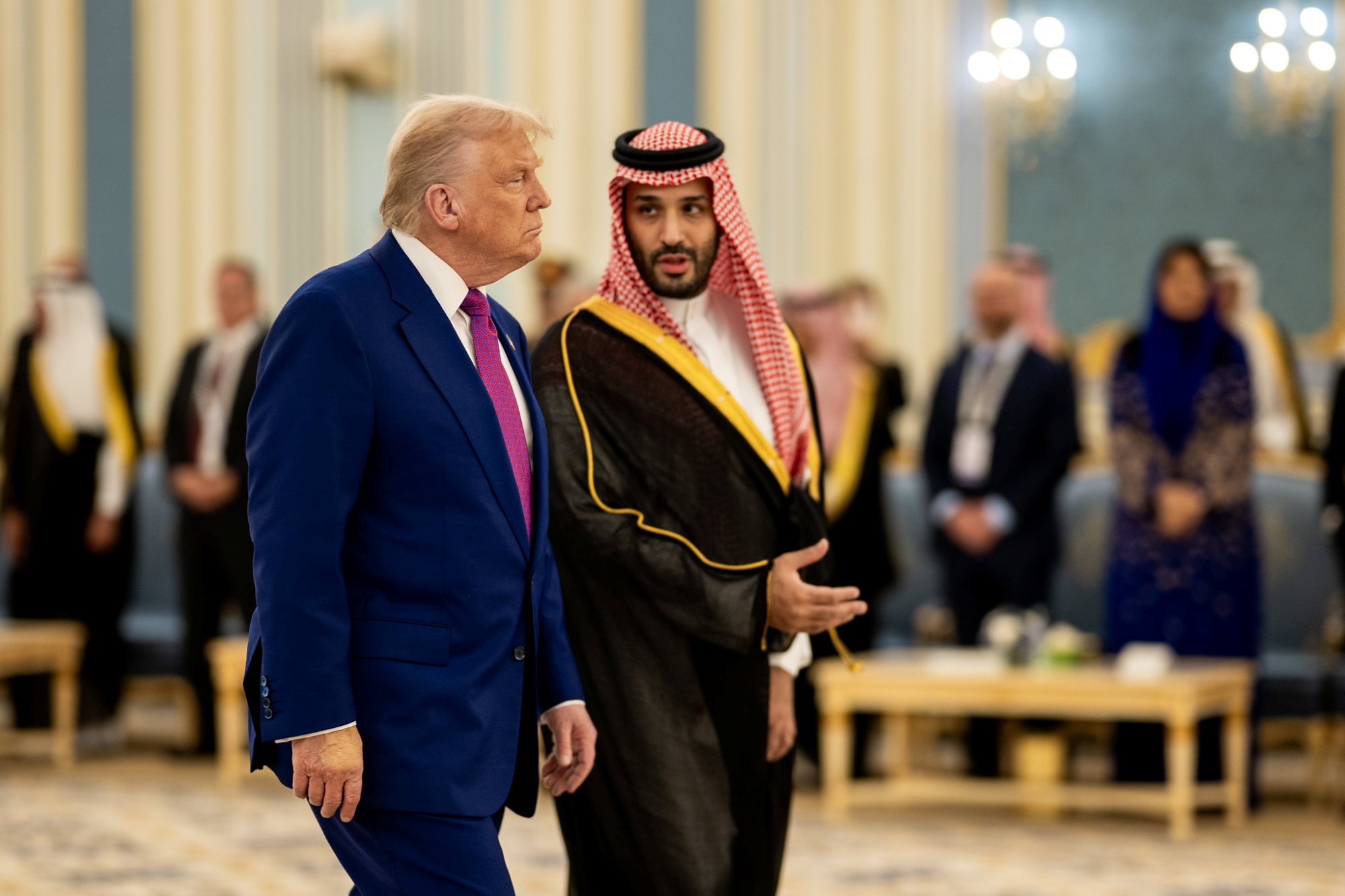
U.S. President Donald Trump's visit to Saudi Arabia and several Gulf states in May 2025 once again sparked widespread debate following the announcement of agreements and investment commitments valued at around $1 trillion. Many commentators quickly interpreted this figure as evidence that the Gulf states were financing the U.S. economy, or that economic relations between the two sides were fundamentally based on a one-way flow of capital from the Gulf to the United States.
This narrative tends to reappear whenever major deals or investment commitments are announced between the two sides. Large headline figures are often interpreted as money being "given" to the United States, while a more important question is frequently overlooked: What do these figures actually mean from an economic perspective? Do they really represent a transfer of wealth from one country to another, or are they investments designed to generate returns for those who make them?
Answering this question requires looking beyond the value of announced deals or political statements. Such announcements may include memoranda of understanding, long-term investment plans, or projects scheduled to be implemented over many years, and therefore do not necessarily reflect the amount of capital that has actually been invested. For this reason, international statistical institutions such as the International Monetary Fund (IMF), through its Balance of Payments and International Investment Position Manual (BPM7), and the United Nations Conference on Trade and Development (UNCTAD), through its World Investment Report, rely on indicators such as foreign direct investment (FDI). Unlike political announcements, FDI measures the assets that investors actually own in foreign economies, making it a more accurate indicator of cross-border investment activity.
Drawing on these official data, this article examines the nature of mutual investment between the United States and the Gulf states. It relies primarily on data from the U.S. Bureau of Economic Analysis (BEA), together with reports published by UNCTAD and the IMF, to assess whether this relationship reflects a one-way transfer of wealth or, instead, a network of reciprocal investments and shared economic interests that differs substantially from the common narrative found in political and media discourse.
Do Announced Deals Reflect the True Scale of Economic Relations?
Economic agreements announced during official visits are often presented as direct evidence of the amount of money flowing from one country to another. However, this interpretation does not reflect how international economic relations are measured in official statistics. Political announcements may include memoranda of understanding, contracts implemented in phases, or investment plans that unfold over many years. As a result, their headline value can differ significantly from the amount of capital that has actually been invested.
For this reason, statistical agencies do not use the value of announced deals to measure investment relations between countries. According to the International Monetary Fund's (IMF) Balance of Payments and International Investment Position Manual (BPM7), foreign direct investment (FDI) is measured by the assets that investors actually acquire in another economy with the intention of establishing a lasting investment relationship, rather than by the value of political commitments or public announcements. The United Nations Conference on Trade and Development (UNCTAD) follows the same methodology in its World Investment Report 2024 when compiling global FDI statistics.
Consequently, the announcement of investment commitments that may reach US$1 trillion does not mean that this amount has been transferred directly into the U.S. economy, nor does it imply a grant or a financial transfer from one state to another. A significant share of the headline figures announced during the May 2025 trip, in fact, consisted of defence purchases rather than investment in the ordinary sense: Qatar's announced defence purchases alone were valued at $42 billion, while Saudi Arabia committed to buying $142 billion worth of US arms. These are commercial transactions, paid for in exchange for equipment and services, not grants or one-way transfers of wealth — which further complicates any reading of the headline totals as evidence of Gulf capital flowing freely into the US economy.
In most cases, the remaining announced figures include investments to be implemented over several years, corporate acquisitions, joint ventures, commercial contracts, and ownership of productive assets that investors retain with the expectation of generating future economic returns.
Understanding the economic relationship between the United States and the Gulf states therefore requires moving beyond the headline figures that dominate political announcements and focusing instead on data that measure investments actually carried out. In this regard, data published by the U.S. Bureau of Economic Analysis (BEA) are among the most reliable sources, as they record the stock of foreign direct investment between the United States and other economies in accordance with internationally recognised statistical standards.
Political announcements vs. measured data (table)
Same figures as the chart above, with sources
| Figure | Value | Source |
|---|---|---|
| Announced Gulf investment deals (May 2025 trip) | ~$1–2 trillion | White House statements |
| Measured Gulf (Saudi + Qatar + UAE) FDI stock in the US | $47.9 billion | BEA, 2023 |
| Total foreign FDI stock in the US | $5.4 trillion | BEA, 2023 |
| US nominal GDP | $29 trillion | IMF World Economic Outlook, 2024 |
Announced figures reflect political statements, not the BPM7/OECD statistical definition of FDI used for the other three rows — the gap between the first row and the rest is the article's central point.
Announced deals vs. measured investment, on the same scale
USD billion, logarithmic scale — note each gridline is 10× the one below it
Sources: announced deals — White House statements during and after the May 2025 Gulf trip; measured Gulf FDI stock in the US — US Bureau of Economic Analysis (BEA) data for Saudi Arabia, Qatar and the UAE combined, as reported by Al Jazeera (13 May 2025); total FDI stock in the US and US GDP — BEA and IMF World Economic Outlook (April 2025), respectively.
What Do Foreign Direct Investment Data Show?
According to data from the U.S. Bureau of Economic Analysis (BEA), highlighted in a recent Al Jazeera English report, the stock of U.S. foreign direct investment (FDI) in Saudi Arabia stood at approximately US$11.3 billion in 2023, while Saudi FDI in the United States totalled about US$9.6 billion. In Qatar, U.S. FDI reached around US$2.5 billion, compared with US$3.3 billion in Qatari investment in the United States. The United Arab Emirates was the largest Gulf investor in the United States, with an FDI stock of approximately US$35 billion, while U.S. investment in the UAE amounted to about US$16.1 billion, according to BEA data cited by Al Jazeera English.
FDI stock by country, 2023 (table)
USD billion, US Bureau of Economic Analysis
| Country | US FDI stock in country | Country's FDI stock in US | Net direction |
|---|---|---|---|
| Saudi Arabia | $11.3B | $9.6B | Net US → Saudi Arabia |
| Qatar | $2.5B | $3.3B | Net Qatar → US |
| United Arab Emirates | $16.1B | $35.0B | Net UAE → US |
Source: US Bureau of Economic Analysis (BEA), as reported by Al Jazeera (13 May 2025).
US–Gulf foreign direct investment stock, by country, 2023
USD billion; investment runs in both directions, and the balance differs by country
Source: US Bureau of Economic Analysis (BEA), Activities of U.S. Multinational Enterprises and Foreign Direct Investment Position by Country, 2023, as reported by Al Jazeera, "Trump in the Middle East: How much are US-Gulf investments worth?" (13 May 2025).
What is the value of US–Gulf investments? (2016–2023)
Foreign direct investment stock between the US and Saudi Arabia, Qatar and the UAE, both directions, USD billion
Source: US Department of Commerce, as visualised by Al Jazeera, "Trump in the Middle East: How much are US-Gulf investments worth?" (12–13 May 2025).
These figures show not only that investment flows in both directions, but also that investment relationships vary across Gulf countries. Both the UAE and Qatar have accumulated more FDI in the United States than the United States has invested in them, while the opposite is true for Saudi Arabia, where U.S. direct investment surpasses the value of Saudi investment in the United States. This suggests that the economic relationship cannot be reduced to a single narrative that applies uniformly across all Gulf states.
The data also place Gulf investment in the United States into its proper context. According to the BEA, the total stock of foreign direct investment in the United States exceeded US$5.4 trillion in 2023. This means that, although Gulf investments are economically significant, they account for only a small share of total foreign investment in the U.S. economy: the combined Saudi, Qatari, and Emirati FDI stock amounts to roughly $47.9 billion, or well under one percent of the total.
Gulf FDI stock as a share of all foreign investment in the US
Saudi Arabia + Qatar + UAE combined, 2023
Author's calculation: combined Saudi, Qatari and Emirati FDI stock in the US ($47.9bn, BEA/Al Jazeera) as a share of total FDI stock in the US ($5.4 trillion, BEA, 2023).
At the same time, the UNCTAD World Investment Report 2024 identifies the United States as both the world's largest recipient and one of the largest sources of foreign direct investment, reflecting its central position in a highly diversified global investment network rather than any dependence on Gulf capital alone.
Why Does Each Side Invest in the Other?
The United States and the Gulf states invest in one another for different reasons, reflecting the distinct economic advantages that each offers. Yet both share the same fundamental objective: generating returns on capital. According to the International Monetary Fund's (IMF) Balance of Payments and International Investment Position Manual (BPM7), foreign direct investment (FDI) is an economic decision through which investors acquire productive assets abroad in order to establish a lasting investment relationship and earn future returns, rather than transferring wealth from one country to another.
For U.S. companies, Gulf economies have become increasingly attractive investment destinations as a result of the region's ambitious economic transformation programmes. In Saudi Arabia, for example, the National Investment Strategy aims to increase annual net FDI inflows to SAR 388 billion by 2030, while raising the contribution of investment to GDP. These reforms, implemented under Saudi Vision 2030, have expanded opportunities for foreign investors across sectors such as energy, manufacturing, technology, tourism, logistics, and infrastructure, attracting growing interest from American firms.
For Gulf sovereign wealth funds and private companies, the attractiveness of the United States is primarily rooted in the characteristics of its economy rather than political considerations. The United States hosts the world's largest equity market, with the market capitalisation of U.S.-listed companies exceeding US$60 trillion in 2024, according to the World Federation of Exchanges (WFE). It is also home to many of the world's leading firms in technology, artificial intelligence, healthcare, energy, and advanced manufacturing, making it a natural destination for long-term investors seeking portfolio diversification and higher returns.
The investment portfolios of Gulf sovereign wealth funds reflect this strategy. According to the Sovereign Wealth Fund Institute (SWFI), the Public Investment Fund (PIF) of Saudi Arabia, the Abu Dhabi Investment Authority (ADIA), and the Qatar Investment Authority (QIA) together manage assets exceeding US$2 trillion. Their portfolios are diversified across the United States, Europe, and Asia, encompassing listed equities, real estate, infrastructure, private equity, and technology companies. This geographical diversification indicates that investment in the United States forms part of a broader global asset allocation strategy rather than being a feature unique to U.S.-Gulf economic relations.
This pattern is consistent with the findings of UNCTAD's World Investment Report 2024, which shows that multinational enterprises allocate investment to markets offering stronger prospects for growth and profitability. Likewise, the OECD Benchmark Definition of Foreign Direct Investment (Fifth Edition) emphasises that the primary purpose of FDI is to establish a long-term economic relationship that generates benefits for the investor, rather than to provide financial support to the host country.
From this perspective, many of the public reactions to the announcement of Saudi investment commitments that could reach US$1 trillion confused investment with financial transfers. Such commitments do not imply that US$1 trillion is being transferred to the U.S. Treasury. Rather, they encompass investments implemented over many years through corporate acquisitions, joint ventures, productive assets, and commercial projects that remain owned, wholly or partially, by the investor and are expected to generate future returns.
The same misunderstanding can arise in the interpretation of high-profile political events. For example, Qatar's announcement that it would provide a Boeing 747-8 for temporary use under the Air Force One programme generated extensive media attention and political debate in the United States. However, this episode does not constitute an economic indicator used by international statistical institutions to measure investment relations between countries. Instead, it represents a specific political and governmental arrangement that is fundamentally different from foreign direct investment or cross-border capital flows.
For these reasons, assessing the economic relationship between the United States and the Gulf states requires relying on data that measure actual investment stocks and flows rather than the headline value of announced deals or politically significant events. While such announcements may shape public debate, they do not necessarily reflect the underlying structure of economic relations between the two sides.
An Asymmetrical Relationship, but Not One of Dependency
Mutual investment does not imply that the United States and the Gulf states have equal economic weight. The United States remains the world's largest economy, with a nominal GDP of approximately US$29 trillion in 2024, according to the International Monetary Fund's (IMF) World Economic Outlook. It also benefits from the global role of the U.S. dollar, which remains the dominant currency for international reserves, trade, and financial markets. Together, these factors give the United States a greater ability to attract international capital and shape the global financial system.
The Gulf states, however, possess a different set of economic strengths. They account for roughly 30% of the world's proven oil reserves and manage some of the world's largest sovereign wealth funds. According to the Sovereign Wealth Fund Institute (SWFI), the Public Investment Fund (PIF) of Saudi Arabia, the Abu Dhabi Investment Authority (ADIA), and the Qatar Investment Authority (QIA) together manage assets exceeding US$2 trillion, making them among the most influential institutional investors in global financial markets. At the same time, economic diversification programmes have transformed the region into an increasingly attractive destination for foreign investment in manufacturing, renewable energy, technology, logistics, and other non-oil sectors.
These differences reflect distinct sources of economic strength rather than a relationship of dependency. The United States offers deep capital markets, world-leading technology firms, and a strong capacity for innovation, while the Gulf states provide abundant capital, strategic energy resources, and sovereign investors seeking global investment opportunities. Each side therefore possesses assets that the other values, helping to explain the continued flow of investment in both directions despite their unequal economic size.
This pattern is also consistent with the UNCTAD World Investment Report 2024, which shows that foreign direct investment flows both from advanced economies to resource-rich economies and in the opposite direction. Likewise, BEA data demonstrate that U.S. companies invest directly in Gulf economies while Gulf sovereign wealth funds and corporations invest in the United States. The evidence therefore points to a relationship based on reciprocal economic interests rather than a one-way transfer of wealth.
For these reasons, describing the economic relationship between the United States and the Gulf states as one of dependency is not supported by the available evidence. Economic interdependence does not imply equality of power, nor does the technological or financial dominance of one country automatically mean that mutual investment benefits only one side. Both the United States and the Gulf states invest in each other's economies because they expect economic returns, even if the nature and scale of those benefits differ.
Conclusion
The debate surrounding the announcement of Saudi investment commitments that could reach US$1 trillion illustrates how easily political narratives can be confused with economic reality. Large investment announcements or high-profile agreements do not necessarily imply that such amounts are transferred to another country's economy, nor do their headline figures accurately reflect the value of investments actually carried out or the returns they are expected to generate.
Official data published by the U.S. Bureau of Economic Analysis (BEA), together with the statistical methodologies of the International Monetary Fund (IMF) and the United Nations Conference on Trade and Development (UNCTAD), show that investment relations between the United States and the Gulf states are characterised by two-way capital flows. On both sides, investors acquire productive assets with the expectation of generating long-term economic returns. Although the United States retains clear advantages in terms of economic size, financial markets, and technological leadership, this does not mean that Gulf investments constitute financial support for the U.S. economy, just as U.S. investments in the Gulf cannot be regarded as economic aid.
The evidence therefore suggests that understanding international economic relations requires distinguishing between political commitments and actual investments, between financial transfers and asset ownership, and between asymmetry in economic power and economic dependency. Viewed through this analytical framework, the relationship between the United States and the Gulf states emerges as one based on reciprocal investment and shared economic interests rather than the one-way transfer of wealth often portrayed in political and media narratives.
This article was originally written in Arabic. The English translation was produced partially with the help of AI.