
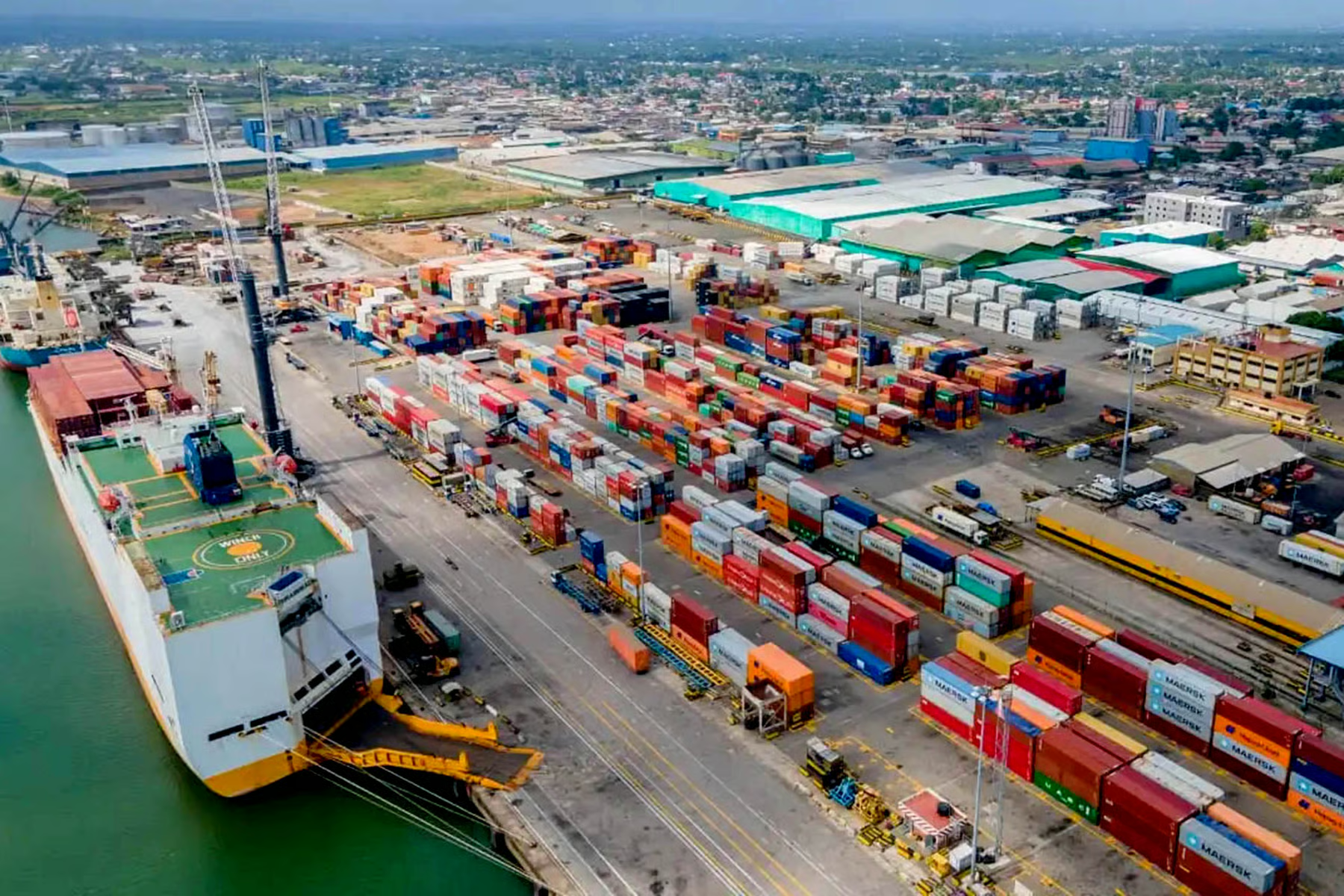
Recently, I came across a number of indicators related to the Moroccan economy. Setting aside the political and sporting debates that often dominate discussions about relations between countries in the region, two figures in particular caught my attention.
The first was that net foreign direct investment (FDI) inflows reached nearly MAD 28 billion during the first half of 2025, representing an increase of around 74% compared with the same period a year earlier. This reflects the growing attractiveness of the Moroccan economy to international investors.
The second was that Moroccan institutions secured eight of the top ten positions in the latest ranking of preparatory classes across Africa.
I find that these two indicators reflect the outcomes of a long-term vision based on sustained efforts to attract investment while simultaneously investing in human capital through education and skills development. They suggest that economic competitiveness is built not only by creating a favourable business environment, but also by preparing the workforce needed to support long-term growth.
The Results of Years of Sustained Investment
According to the World Bank, the Moroccan economy has demonstrated remarkable resilience despite recurrent droughts and a challenging global economic environment. In its 2025 Morocco Economic Monitor, the Bank reported that non-agricultural growth reached around 3.8% in 2024, supported by a recovery in industry and investment. It also noted that foreign direct investment (FDI) inflows continued to finance a significant share of the current account deficit, reflecting sustained investor confidence in the Moroccan economy.
This progress was not the result of chance. Rather, it reflects the outcome of industrial policies implemented over more than two decades, centred on the development of specialised industrial zones, their integration with ports and transport infrastructure, and Morocco's gradual integration into global value chains.
The automotive sector is perhaps the clearest example of this strategy. It has become Morocco's largest export industry, with major international manufacturers such as Renault and Stellantis establishing large production facilities, supported by an extensive network of global suppliers. More recently, Morocco has also attracted growing interest from Chinese electric vehicle manufacturers and battery producers, which increasingly view the country as a manufacturing and export platform for the European market. This strategy is supported by Morocco's free trade agreements with the European Union, its strategic geographic location, and its increasingly competitive logistics infrastructure.
A similar pattern can be observed in the aerospace industry, where global companies such as Boeing and Safran have established production activities manufacturing components for the international civil aviation industry. At the same time, Morocco has begun positioning itself in industries linked to the green transition through investments in electric vehicle battery production and green hydrogen projects. Together, these developments illustrate a long-term industrial strategy aimed not only at attracting investment, but also at moving up global value chains and diversifying the country's productive base.
Investing in Education Before Investing in Industry
Building a competitive industrial sector requires more than factories and capital. It also depends on the availability of engineers, technicians, researchers, and a skilled workforce capable of supporting technological progress and industrial expansion. For this reason, Morocco's strategy has not been limited to attracting manufacturers. It has also included sustained investment in human capital through engineering schools, vocational training institutions, and preparatory classes.
At the same time, World Bank reports emphasise that Morocco's education system continues to face important challenges related to education quality and human capital development, highlighting the need for continued reforms. Nevertheless, there is a clear policy direction towards aligning education and training with the needs of the economy, particularly as the automotive, aerospace, and renewable energy industries continue to expand. These sectors require increasingly specialised technical skills and a workforce capable of meeting the demands of advanced manufacturing.
Infrastructure Is Not a Cost, but an Investment
It is difficult to discuss investment attractiveness without considering infrastructure. Investors are not only concerned with labour costs or tax incentives. They also look at the efficiency of transport networks, the speed of moving goods, the quality of logistics services, and the overall connectivity of the country.
Morocco's preparations for the 2025 Africa Cup of Nations and the 2030 FIFA World Cup, which it will co-host with Spain and Portugal, have highlighted the country's substantial infrastructure capacity while accelerating investment in airports, highways, railways, urban transport, stadiums, and hospitality facilities. The significance of these projects, however, extends well beyond the sporting events themselves. Their real value lies in the long-term economic legacy they create by improving connectivity between regions, supporting tourism, increasing productivity, and further enhancing Morocco's attractiveness as an investment destination. According to the World Bank, public investment, partly driven by preparations for the 2030 World Cup, has been one of the main engines of Morocco's recent economic growth.
A Broader Lesson for the Region
Discussing Morocco is not about presenting it as a perfect model. The country continues to face significant challenges, including unemployment, regional disparities, water scarcity, and rising public debt. Yet despite these constraints, it has maintained a relatively consistent strategic direction over the past two decades in areas such as industrial policy, infrastructure development, energy, and investment promotion.
By contrast, many countries in the region continue to struggle to establish a stable long-term economic vision. Development strategies have often changed with political cycles, while the implementation of structural reforms has remained limited. As a result, short-term political considerations have too frequently taken precedence over long-term economic priorities.
The issue is therefore not simply whether a country adopts a new development strategy, but how that strategy is designed. Public participation in identifying local priorities is an essential component of any democratic system. However, it cannot replace economic expertise and evidence-based policymaking when designing industrial, energy, or trade policies. These areas require rigorous economic analysis, technical expertise, forward-looking assessments, and close coordination between governments, the private sector, universities, and research institutions.
The Main Lesson
Economic development is not the outcome of isolated policy decisions. It is the result of a long-term vision that is consistently pursued over time.
Investing in education and aligning it with the needs of the economy, developing modern infrastructure, implementing coherent industrial policies, and improving the business environment are complementary elements of the same strategy. Together, they strengthen economic competitiveness, attract investment, and create sustainable employment opportunities.
Perhaps this is the most important lesson that other countries can draw from Morocco's experience, beyond short-term comparisons or political debates. Sustainable development is not built through slogans, but through policy continuity, strong institutions, and the ability to plan for decades rather than years.