
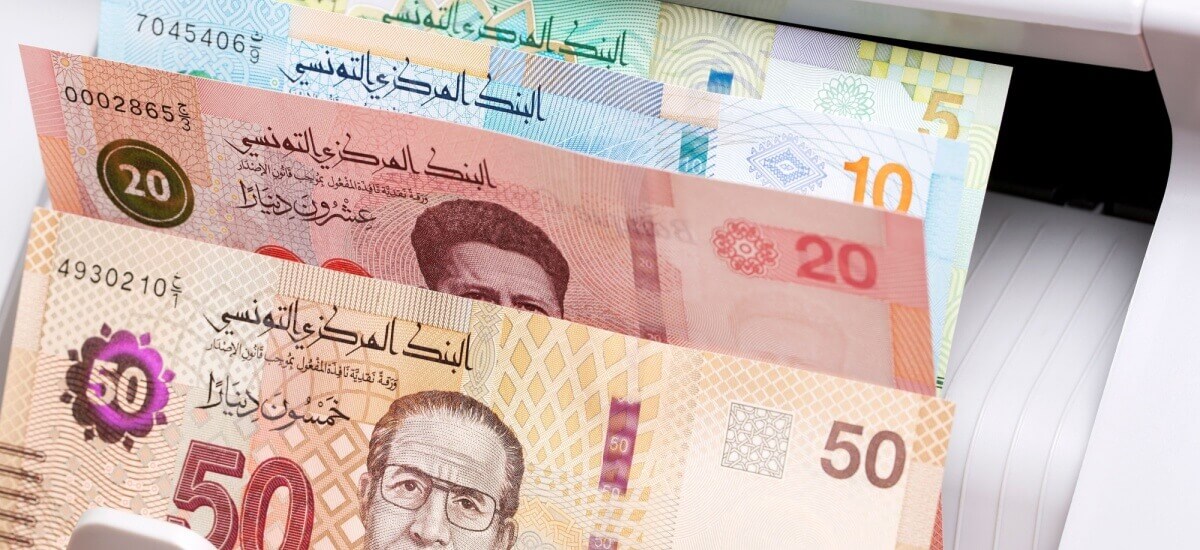
A recent statement by the Tunisian Prime Minister caught my attention. She said that the Tunisian dinar is the strongest currency in Africa. If read as evidence of a strong Tunisian economy, that statement is misleading: the nominal exchange rate she relied on is not the measure economists actually use to judge how strong a currency is.
To see why, we need to separate three concepts that public debate often blurs together: the real exchange rate, the real effective exchange rate, and purchasing power parity, which allows us compare them in practice. I will use these three tools, together with an actual comparison of living costs across a number of African countries, to answer the real question: does a nominally "strong" dinar actually give Tunisia a better competitive position than its neighbours?
The Nominal Exchange Rate: Why It Isn't Enough
The nominal exchange rate is the price of one currency expressed in units of another: when we say one dinar is worth a given amount of euros (1 TND = E × 1 EUR), that is exactly what we are talking about, and nothing more.
The problem is that this indicator measures only the relative value of two currencies in the foreign exchange market, with no reference to price levels inside each country. A currency can be nominally "strong" even while domestic prices are very high, in which case neither citizens nor foreign investors actually benefit from that apparent "strength." This is precisely why economists refuse to judge a currency's strength from the nominal exchange rate alone.
The Real Exchange Rate (RER)
The real exchange rate corrects this shortcoming: alongside the nominal rate, it accounts for the gap between domestic and foreign price levels:
Where $E$ is the nominal exchange rate, $P^{*}$ the foreign price level, and $P$ the domestic price level.
If domestic prices rise while the nominal exchange rate remains unchanged, the currency undergoes a real appreciation. Domestic goods become more expensive relative to foreign goods, reducing the country's external competitiveness even though the nominal exchange rate has not changed. Conversely, a relative decline in domestic prices leads to a real depreciation, making domestic goods more competitive regardless of the nominal exchange rate.
This also highlights the limitations of relying solely on the nominal exchange rate when assessing a currency's value. A stronger nominal dinar does not necessarily mean that the currency has become stronger or weaker in economic terms, because the real exchange rate also depends on changes in price levels in Tunisia relative to those of its trading partners. Therefore, the competitiveness of the economy cannot be assessed using the nominal exchange rate alone.
The Real Effective Exchange Rate (REER)
But the real exchange rate is still a bilateral measure: it compares one country's currency with a single partner's. Since Tunisia trades with many partners at once, it makes more sense to use the real effective exchange rate (REER), a weighted average of bilateral real exchange rates against all trading partners combined:
Where $w_i$ is the trade weight of partner $i$, its share of Tunisia's total foreign trade.
A REER appreciation means Tunisia is losing competitiveness against all of its trading partners taken together, not against one country in particular. This is the indicator monetary policymakers actually rely on, not the nominal exchange rate the Prime Minister cited.
From Purchasing Power Parity to an Actual Comparison
Calculating the real and real effective exchange rates precisely requires official data on price levels and trade weights for every partner, data that is not published regularly or in detail for every country. This is why economists sometimes turn to a simpler benchmark: purchasing power parity (PPP), which directly compares the cost of an identical basket of goods between two countries, once converted into a common currency:
If domestic prices, once converted at the prevailing exchange rate, are higher than foreign prices, the domestic currency is relatively "overvalued" by this standard.
This is exactly the logic behind the comparison below: I compared the cost of a standardised basket of essential goods and services, bread, milk, rice, meat, rent, transport, communications, electricity and water, clothing, across 9 African capitals, after converting all prices to euros at each currency's current nominal exchange rate. The basket is approximate and does not follow the World Bank's International Comparison Program (ICP) methodology, but it is enough to illustrate the point.
Cost of a basic goods and services basket — comparison across 9 countries
Prices converted to euros; weighted by spending category
The last row expresses each country's basket cost as a share of Tunisia's (Tunisia = 100), allowing a direct comparison independent of currency units. Author's estimate, prices collected locally and converted to euros.
The result is striking: the same basket, converted to euros at the prevailing exchange rate, costs only about 75% as much in Egypt as it does in Tunisia, about 78% in Algeria, and about 78% in Libya as well. In other words, three currencies usually described as nominally "weaker" than the dinar, the Egyptian pound, the Algerian dinar, and the Libyan dinar, actually buy the same basket for less in foreign-currency terms than the "strong" dinar does.
This comparison is approximate and does not amount to an official calculation of the real or real effective exchange rate, but it is enough to challenge the conclusion one might draw from the Prime Minister's statement: nothing in it suggests that a nominally "strong" dinar gives Tunisia a genuine price advantage over its closest neighbours. That is entirely consistent with the logic of the real exchange rate: a currency can rise in nominal value while at the same time being "overvalued" in real terms once compared with domestic price levels.
Conclusion
The Prime Minister's statement is literally true from the standpoint of the nominal exchange rate, but misleading if read as evidence of the strength of the Tunisian economy. The comparison above shows that countries with currencies nominally "weaker" than the dinar actually offer a lower cost of living in foreign-currency terms, consistent with the real exchange rate, not the nominal one, being the right yardstick for judging a currency's strength.
It follows that economic policy should not aim to raise the dinar's nominal value for its own sake, but rather to preserve price stability, improve productivity, and strengthen the Tunisian economy's real external competitiveness. These are the factors that actually determine the strength of a currency, not the number that appears on the exchange-rate ticker.